
Ghost Controls Gate Repair in Little Elm: A Homeowner’s Guide
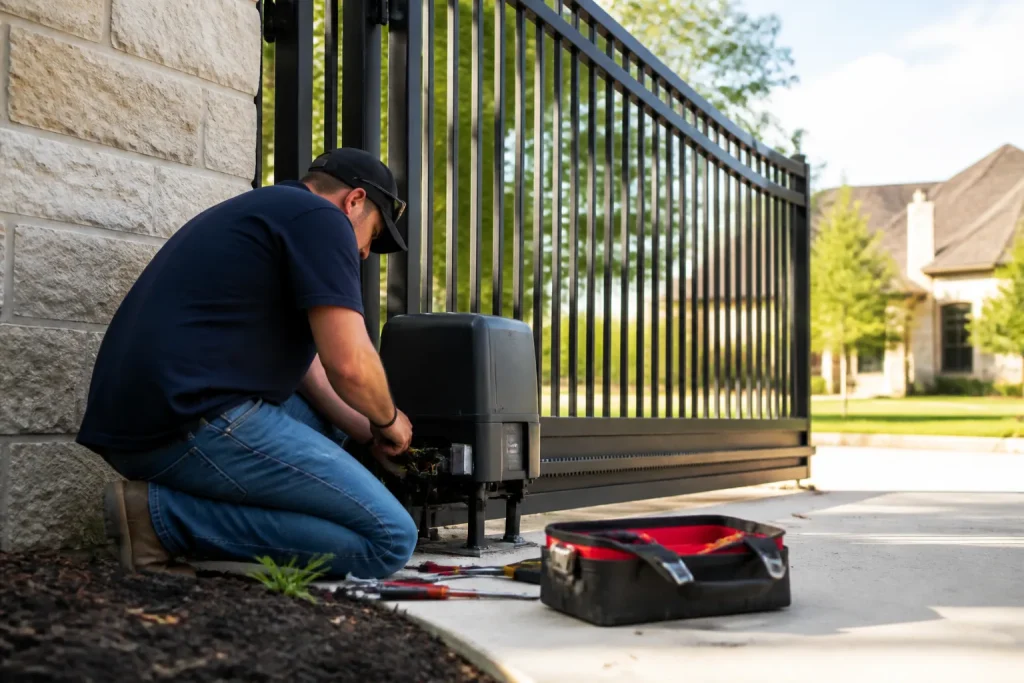
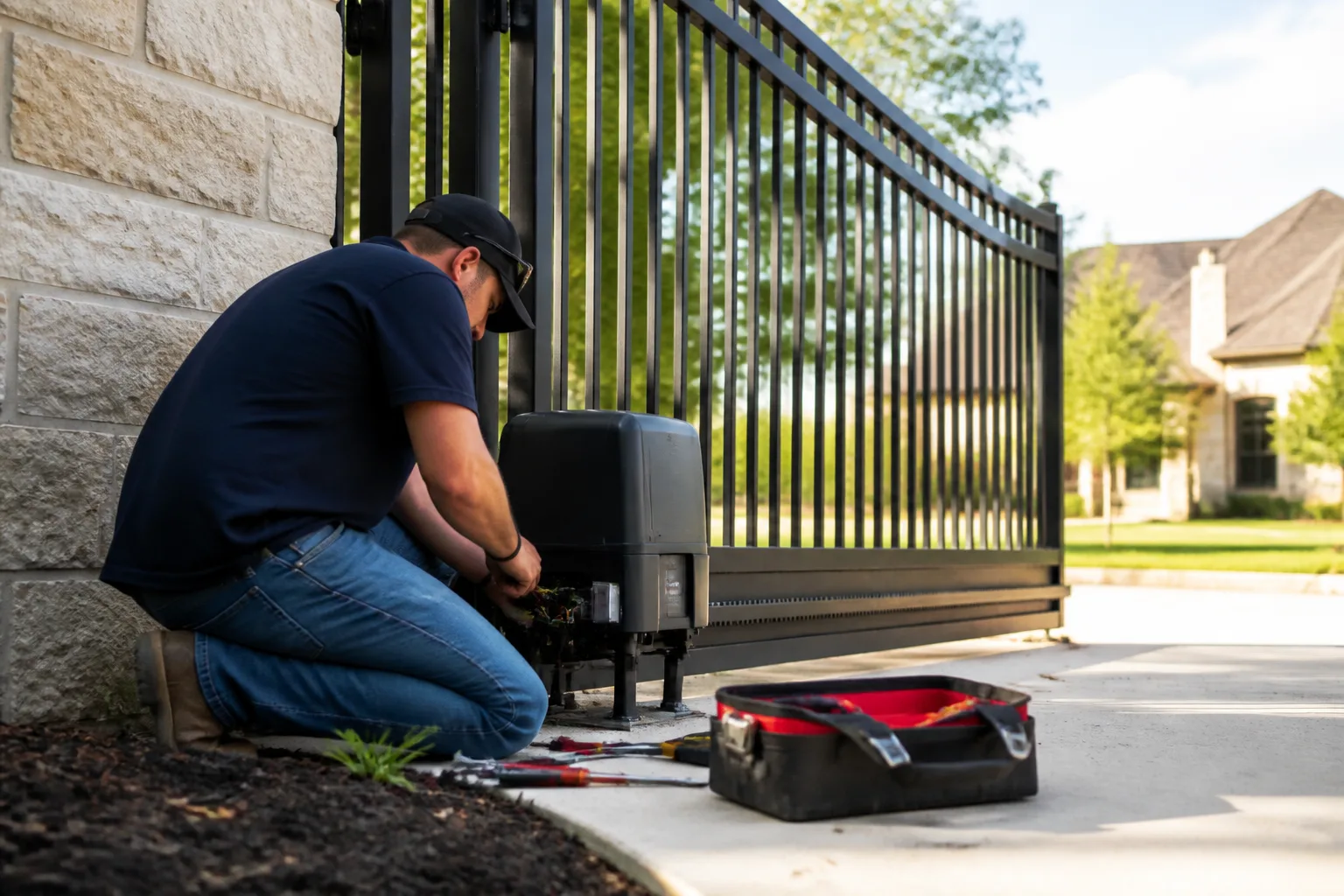
Ghost Controls gate repair in Little Elm usually comes down to one of three problems: a solar panel that isn’t getting enough sun, a battery that’s been cooked by Texas heat, or a control board that’s been confused by a power interruption. Most of these can be fixed in a single visit by a technician who knows the system. If you’d rather not troubleshoot it yourself, call (432) 547-6481 and we’ll send someone who does.
Here’s the thing about Ghost Controls openers that nobody tells you at the hardware store: they were designed for wide-open rural properties. Ranches, acreage, places where a solar panel sits in full sun from dawn to dusk and the gate might cycle twice a day. Little Elm is not that place. Our subdivisions are built under mature oaks and pecans, our lots run east-west, and our HOA gates open and close dozens of times before noon. That mismatch is the root of nearly every Ghost Controls failure we see in this town.
We’ve been repairing gates in Little Elm for years, and we’ve pulled Ghost Controls units out of garages in neighborhoods from Paloma Creek to Valencia that were limping along on a third of the power they were rated for. The homeowner always blames the battery. It’s rarely the battery.
How Little Elm’s Shade and Lot Orientation Starve Ghost Controls Solar Panels
Ghost Controls publishes their solar panel output numbers based on direct, unobstructed sunlight at high noon. That is a perfectly honest test. It is also a fantasy for most Little Elm homeowners. A panel mounted on a gate post under a live oak canopy in Oak Point or on the shaded side of a fence line in Frisco Hills might get two hours of full sun on a good day. The rest of the time it’s operating at 20 to 30 percent of rated output. The system never fully charges. The battery runs down. The gate gets slower, then stops responding, then quits entirely.
What you should look at is the charge reading on the control board, not the output rating on the panel. A healthy Ghost Controls system in North Texas should hold a charge above 12.4 volts during the day. If your reading is sitting below 11.8 volts at noon on a sunny day, your panel is not keeping up with your gate’s actual use. That’s not a battery problem. That’s a siting and sizing problem.
We see this pattern constantly in the east-west oriented lots common across Little Elm. The gate faces north, the sun tracks across the top of the fence line, and the panel never catches more than glancing light. Adding a second panel, repositioning the existing one, or switching to a trickle-charge AC setup when power is available at the gate line are all legitimate fixes. The wrong fix is replacing the battery and hoping for the best. We’ve met too many homeowners who did that twice before calling us.
The Three Ghost Controls Failure Modes That HOA Communities See (and Rural Users Don’t)
Ghost Controls builds a solid unit for the low-cycle rural use case. But in Little Elm’s HOA communities, where a shared gate might cycle 60 or 80 times a day during summer, different components wear out first. Here are the three failures we see most often:
- Relay fatigue at the control board. Every open and close cycle burns through a relay actuation. A rural gate that cycles 10 times a day doesn’t put much wear on the relays. A Little Elm HOA gate that cycles 80 times a day does. The first symptom is a gate that intermittently ignores remote commands. The second symptom is a gate that only responds every third or fourth try. The fix is a new control board, not a new remote.
- Battery cooking in the July heat. Little Elm summers push surface temperatures past 140 degrees on gate-mounted enclosures. Lead-acid batteries don’t like that. They lose capacity faster, and they gas off sooner. A battery that should last three years in a shaded rural installation might last 14 months on a south-facing brick pillar in Paloma Creek. If you’re replacing Ghost Controls SLA batteries every summer, your enclosure needs ventilation or relocation.
- Actuator arm loosening from frequent cycling. The Ghost Controls linear actuator uses a threaded rod driven by the motor. Frequent cycles create heat, heat creates expansion, and expansion slowly backs the arm out of adjustment. The gate starts sagging, catches on the latch, or drifts out of plumb. This is a mechanical failure that no reset sequence will fix.
In our experience, homeowners who’ve read the Ghost Controls troubleshooting guide cover to cover usually know the reset sequence by heart. What they don’t realize is that the reset sequence is designed for firmware glitches and programming conflicts, not for mechanical wear or electrical failure. Running it over and over on a gate with a cooked relay just wears out your patience.
Why the Reset Sequence in the Manual Often Masks the Real Problem
The Ghost Controls manual offers a reset sequence for most error conditions. Hold this button, wait for the beep, release, and the system reboots. For a genuine programming hiccup, that works fine. But here’s what we run into in Little Elm regularly: clay soil, high humidity, and years of freeze-thaw cycles create corrosion at the terminal connections. The wires still conduct, but they’re down to 60 or 70 percent contact. Every time the gate draws power, voltage drops. The system trips a fault. The homeowner resets it. The gate works for a day or two. Then it trips again.
The reset is masking a physical problem. In Little Elm’s heavy clay, the ground shifts seasonally. Cables buried shallowly, or run through conduit that’s been knocked askew by shifting soil, get stressed. Connections at the junction box oxidize. A technician who opens the junction box and actually looks at the wire ends will find green corrosion and cracked insulation. That’s the real fault. The reset button never fixed anything; it just told the board to stop complaining for a while.
We pulled a Ghost Controls unit from a home over in Lantana last month where the homeowner had reset the system eleven times in six weeks. Eleven. The problem was a ground wire that had corroded to the point of being decorative. We replaced the conductor, cleaned the terminals, and the gate has run without a single fault since. The reset was never going to fix that wire.
What a Certified Technician Checks That a Homeowner Can’t See
There are two adjustments on a Ghost Controls actuator that simply cannot be verified without the right tools and experience. The first is actuator arm torque calibration. The motor drives a threaded shaft inside the actuator. If the torque setting drifts too high, the arm will strain the hinges and warp the gate frame over time. Too low, and the arm won’t push the gate through the full travel. Factory calibration is set for a specific load range, and a Little Elm gate that’s heavier than spec, or one that’s been hit by a delivery truck, or one that’s just old and sagging, needs that calibration adjusted. There’s no app for that. It’s a physical measurement with a torque meter on the arm.
The second is receiver sensitivity drift. Ghost Controls receivers are surprisingly good, but the components inside them degrade with heat exposure. In Little Elm’s summer, a receiver box mounted in a metal cabinet facing west can see internal temperatures that accelerate that drift. The result is a remote that only works from 20 feet away instead of 60. Homeowners replace remote batteries, then buy new remotes, then blame the opener. The fix is often as simple as retuning the receiver or relocating the antenna. A technician with a signal meter can see the drift in five minutes. A homeowner cannot see it at all.
These are the jobs where calling a specialist saves real money. None of this is about replacing the whole opener. It’s about adjusting what’s there so it works the way it was built to work. Our gate motor and opener service in Little Elm covers exactly these calibrations.
When to Repair a Ghost Controls Unit vs. When the Numbers Say Switch Brands
Being honest here matters more than selling an opener. A Ghost Controls system that’s under five years old, in decent condition, and failing because of one identifiable component is almost always worth repairing. A new control board runs a fraction of a full replacement. A new actuator arm is a straightforward swap. Those repairs make sense, and we do them regularly.
But there’s a point where the cost-per-cycle math tips the other way. If your Ghost Controls unit is over eight years old, has had two or more major component replacements, and lives on a gate that cycles 40 or 50 times a day, you’re spending more per year keeping it alive than you’d spend on a new opener from a brand built for high-cycle residential use. FAAC and BFT both make openers engineered for exactly that kind of duty. We’re certified on those brands, along with Linear, Viking, and others, and we’ll tell you plainly when it’s time to switch. We won’t take the job if we don’t think it’s the right call.
For most single-family driveway gates in Little Elm, a well-maintained Ghost Controls system has years left in it. The key words are “well-maintained.” What kills these units isn’t age. It’s being ignored until something stops working, then being reset, then being ignored again.
When to Call a Pro
If your Ghost Controls gate has failed more than twice in the same season, or if you’re seeing corrosion at any connection point, or if the gate has started moving slower than it did last year, stop resetting it and have someone look at the actual components. The problem is not going to fix itself, and every additional fault cycle puts more strain on the motor, the board, and the gate hardware itself. A gate that fails hard against a closed latch can bend a hinge, crack a weld, or damage the actuator internally. What starts as a $150 board replacement becomes a $900 mechanical repair.
Related services in Little Elm: Gate Repair in Little Elm | Gate Installation in Little Elm
The Bottom Line
Ghost Controls makes a capable opener for the right application. The problem in Little Elm is that the application is rarely what the design assumed. Shaded panels, hot batteries, high-cycle HOA use, and clay-soil corrosion all work against these systems in ways the instruction manual doesn’t anticipate. The fix is rarely a reset. It’s usually a real diagnostic look at the panel siting, terminal condition, torque calibration, and receiver health. Most Ghost Controls repairs in Little Elm are straightforward and can be completed the same day. Some situations genuinely call for a different opener brand, and we’ll tell you that straight.
If you’re in Little Elm and need help with a Ghost Controls gate, Ironworks Gate Co. offers free estimates. Call (432) 547-6481 and a live person answers, day or night. We’ll quote the job before we turn a single bolt, and every repair is backed by our written 90-Day Done Right Promise. That’s been our standard since 1984, and it hasn’t changed.
For more about who we are and the full scope of work we do, visit the Ironworks Gate Co. home page.
Frequently Asked Questions
Most Ghost Controls repairs in Little Elm fall between $150 and $400 depending on the failed component. A new control board or actuator arm replacement lands in the $200 to $350 range including labor, while simpler fixes like terminal cleaning or receiver retuning run $150 to $200. We always quote the exact price before work starts, and you’ll never see a surprise on the bill afterward. Call (432) 547-6481 for a free estimate on your specific system.
In most cases, yes. The common Ghost Controls failures we see in Little Elm, failed relays, corroded terminals, fatigued actuator arms, and heat-degraded batteries, are handled from our service vehicles on a single visit. We stock Ghost Controls boards, actuators, and receivers so we don’t have to order parts and come back. Scheduling is simple: call (432) 547-6481 and we’ll tell you when we’ll be there, then we’ll be there.
Intermittent operation almost always points to one of four issues: a relay on the control board wearing out, a terminal connection corroding enough to drop voltage under load, a receiver that’s drifting from heat exposure, or a battery that’s lost enough capacity to fail under peak draw. The reset button won’t fix any of those. A technician can isolate the cause in one visit.
If your unit is under five years old and the failure is a single component like a board, arm, or receiver, repair it. If it’s over eight years old, has already had multiple major repairs, and cycles 40 or more times daily, the long-term math favors a new opener from a brand built for high-cycle use. We service Ghost Controls and eight other major brands, so we’ll give you the honest comparison and let you decide. Call (432) 547-6481 and we’ll assess it at no charge.
Written by Victor Salinas, Owner at Ironworks Gate Co., serving Little Elm since 2013.
Need Gate Repair Help?
Call Ironworks Gate Co. - licensed & insured, here with fast after-hours help in Little Elm.
(432) 547-6481